SUN ELECTRIC 759-105 Infrared Ppm Hc Exhaust Gas Analyzer Meter Nos Box Gauge
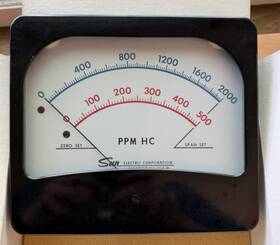
( Brand: Sun Electric ), ( Manufacturer Part Number: 759-105 ), ( Accessories: Meter ), ( Type: Engine Analyzer ), ( Country Of Origin: United States )
Review SUN ELECTRIC Vintage Infrared Ppm Hc Exhaust Gas Analyzer Meter Nos In Box Gauge
The **Sun Electric 759-105 Infrared (IR) PPM HC Exhaust Gas Analyzer Meter** is a precision-engineered, professional-grade diagnostic tool designed for accurate measurement of hydrocarbon (HC) emissions in exhaust gases, making it an indispensable asset for automotive technicians, emissions testing facilities, and environmental monitoring applications. This robust, box-style gauge features a high-precision infrared sensor optimized for detecting trace levels of unburned hydrocarbons in exhaust streams, delivering real-time, reliable readings in parts per million (PPM) with exceptional sensitivity and repeatability. Built with a durable, rugged construction, the 759-105 is constructed from high-quality materials to withstand the demands of fieldwork, including exposure to vibration, temperature fluctuations, and moisture, ensuring long-term reliability in both laboratory and on-road environments. The meter s large, backlit digital display provides clear, easy-to-read numerical output, while its adjustable zero and span calibration functions allow for precise fine-tuning to match specific testing protocols or equipment standards. Ideal for use with a wide range of exhaust gas analyzers, this infrared sensor operates seamlessly with Sun Electric s broader line of diagnostic tools, offering seamless integration for comprehensive emissions analysis. Whether employed in OBD-II diagnostics, smog check inspections, or emissions testing compliance, the 759-105 delivers unmatched accuracy and performance, empowering technicians to diagnose engine efficiency issues, verify emissions control system functionality, and ensure compliance with stringent environmental regulations. Its compact yet sturdy design, combined with a user-friendly interface, makes it a versatile and practical choice for both professional and semi-professional applications.
The **Sun Electric 759-105 Infrared PPM HC Exhaust Gas Analyzer Meter** is a handheld device used primarily for measuring hydrocarbon (HC) emissions in exhaust gases, often in automotive, industrial, or environmental applications. Below is a detailed breakdown of its pros and cons, followed by a conclusion and recommendation.
---
### **Pros**
1. **Specific and Accurate Measurement**
The device uses infrared (IR) technology to detect hydrocarbon (HC) concentrations in parts per million (PPM), providing precise readings for compliance testing, diagnostics, or emissions monitoring. Infrared sensors are highly selective for hydrocarbons, reducing interference from other gases like CO or CO .
2. **Portable and Handheld Design**
Its compact and handheld nature makes it easy to carry and use in the field, whether for on-road vehicle testing, workshop diagnostics, or mobile emissions inspections. This portability is ideal for technicians who need to test multiple vehicles quickly.
3. **User-Friendly Interface**
The analog or digital display (depending on the model variant) is straightforward, allowing for quick interpretation of results. Some models may include features like zeroing, calibration prompts, or backlit displays for better visibility in low-light conditions.
4. **Cost-Effective for Basic HC Testing**
Compared to more advanced multi-gas analyzers (e.g., those measuring CO, CO , O , and NOx), this device is relatively affordable. It is a cost-effective solution if your primary focus is hydrocarbon emissions rather than a full suite of exhaust gas parameters.
5. **Durable Construction**
The meter is built to withstand field use, with a sturdy casing that can resist minor drops, dust, and moisture (though it may not be fully waterproof). This durability extends its lifespan in demanding environments.
6. **Compatibility with Common Exhaust Systems**
It is designed to work with standard exhaust gas sampling techniques, such as using a probe or adapter for direct measurement. This makes it versatile for testing a wide range of engines, from cars to light-duty vehicles.
7. **Calibration and Maintenance Simplicity**
Basic calibration procedures (e.g., zeroing with clean air or using a calibration gas) are relatively simple, and the device may not require frequent or complex maintenance, reducing downtime.
8. **Useful for Compliance Testing**
In regions where hydrocarbon emissions are regulated (e.g., some environmental or vehicle inspection programs), this analyzer can help ensure compliance by providing accurate HC readings for certification purposes.
---
### **Cons**
1. **Limited to Hydrocarbon (HC) Measurement Only**
The device does not measure other critical exhaust gases such as carbon monoxide (CO), carbon dioxide (CO ), oxygen (O ), or nitrogen oxides (NOx). For comprehensive exhaust analysis, you would need additional meters, which increases cost and complexity.
2. **No Built-In Data Logging or Connectivity**
Unlike some modern analyzers, this model likely lacks Bluetooth, USB, or data logging capabilities. This means you must manually record readings, which can be error-prone and time-consuming, especially during large-scale testing.
3. **Dependence on Proper Sampling Technique**
Accurate readings require correct probe placement and proper exhaust gas flow. If the probe is clogged, misaligned, or exposed to ambient air, the results will be inaccurate. This adds a learning curve for inexperienced users.
4. **Potential for Sensor Drift Over Time**
Infrared sensors can degrade or drift over time, leading to less accurate readings. Regular calibration with certified gases is necessary to maintain accuracy, which may not always be convenient or cost-effective.
5. **Noisy or Inconsistent Readings in Turbulent Exhaust**
In engines with high exhaust turbulence or pulsations (e.g., diesel engines or turbocharged vehicles), the probe may struggle to provide stable readings, leading to fluctuations or inaccuracies.
6. **Limited Lifespan of Consumables**
The infrared sensor and any filters or probes may need replacement after prolonged use, adding to the long-term cost of ownership.
7. **No Display of Additional Useful Metrics**
Unlike more advanced analyzers, this device does not provide metrics like lambda (air-fuel ratio), exhaust temperature, or fuel efficiency indicators, which could be valuable for diagnostics.
8. **Potential for User Error**
Misinterpretation of readings (e.g., confusing PPM HC levels with other units) or improper handling (e.g., exposing the sensor to contaminants) can lead to incorrect conclusions.
---
### **Conclusion**
The **Sun Electric 759-105 Infrared PPM HC Exhaust Gas Analyzer** is a **specialized, cost-effective tool** for measuring hydrocarbon emissions in exhaust gases. It excels in scenarios where only HC levels are required, such as basic emissions testing, workshop diagnostics, or compliance checks for hydrocarbon-specific regulations. Its portability, accuracy for its intended purpose, and simplicity make it a practical choice for technicians or inspectors with limited budgets.
However, its **lack of multi-gas capability, absence of data logging, and reliance on proper sampling techniques** limit its usefulness for comprehensive exhaust analysis or advanced diagnostics. If your primary need is to monitor HC emissions alone and you do not require additional gas measurements, this analyzer is a viable option. For broader exhaust analysis (e.g., CO, O , NOx), investing in a multi-gas analyzer would be more beneficial.
---
### **Recommendation**
- **Buy the Sun Electric 759-105 if:**- You need a **dedicated, affordable HC analyzer** for specific applications (e.g., hydrocarbon emissions testing, basic vehicle diagnostics, or environmental compliance).
- Your workflow does not require measuring other exhaust gases (CO, CO , O , NOx).
- You prioritize **portability and simplicity** over advanced features like data logging or connectivity.
- You are willing to **supplement it with additional tools** (e.g., a separate CO or O meter) for comprehensive testing.
- **Consider an alternative if:**- You need **multi-gas analysis** (e.g., CO, O , NOx) for accurate air-fuel ratio or emissions diagnostics. In this case, a **multi-gas analyzer** (e.g., from Sun Electric s 759 series with additional sensors, or brands like Testo, Horiba, or AVL) would be more suitable.
- You require **data logging, Bluetooth connectivity, or advanced features** like automatic calibration or temperature compensation. Modern analyzers (e.g., Testo 350 or Horiba MEXA-7000) offer these capabilities.
- You work in an **industrial or high-turbulence environment** where stable readings are challenging. A more robust or specialized analyzer may be needed.
- Budget is not a constraint, and you want **long-term reliability with minimal maintenance**. Higher-end analyzers may have longer sensor lifespans and better durability.
For most **basic hydrocarbon testing needs**, the Sun Electric 759-105 is a **solid, budget-friendly choice**. However, if your requirements extend beyond HC, upgrading to a multi-gas analyzer would provide greater versatility and accuracy.
Details:
What you see is what get. There is no mystery here. It fits the Infrared machines with EGA functionality. This listing is for 1 100% NOS Hydro Carbon PPM HC meter.
This is a large meter in excellent NOS cosmetic condition. I cannot guarantee that it functions. You be the judge. The pictures tell the story.
part #: 759105 price
- $249.95
specifications compressionvacu:
- brand: Sun Electric
- mpn: 759-105
- accessories: Meter
- type: Engine Analyzer
- country of origin: United States
payments compressionvacu:
- wallet: Apple-pay
- other
- credit card: Visa
returns compressionvacu:
- policy: No Returns
general compressionvacu:
- condition: Used
- Automotive Tools Supplies > Diagnostic Service Tools > Compression Vacuum Testers
shipping compressionvacu:
- type: Fixed
- class: Standard
- carrier: USPS
- cost: $15.00
- transit: 4-7 Days
- service: USPS Ground Advantage
seller compressionvacu:
- # reviews: 807
- rating: 100.0%
- city: West Linn, Oregon
offer compressionvacu:
- availability: In Stock
- quantity: 1
- sold: 0
- started: May 30, 2026
- options: Ship-to-home
Sun Electric 759-105 Is Similar To:
- 0338-0013 Sun Vintage Engine Vacuum (26% similar) Sun vacuum gauge a must for tuning up vintage engines with carburetors, this is cost effective way to use the tools of era do job right. Large, easy to read dial. I will do my best to answer any questions promptly. Feel free to make an offer, especially on multiple units...(May 31st, 2017)
- 212-1 Sun Electronics Electric Vacuum Gauge Meter Tester Diagnostic Tool Model (41% similar) Comes with hose pictured. Great condition and still works fine. Shipping in the USA only. Sun model vacuum pressure tester...(December 11th, 2018)
- 7893 Sun Vintage Combustion Tester (36.1% similar) Complete unit. Has not been tested. Do not know if it works. Vintage Sun combustion tester model h, 6 volt, part number good overall condition, except the gauge needle is very short, should be longer. Missing one regulator knob...(December 25th, 2017)
- Motor Compression Corp Electric 0-200 Sun 840-1 Vintage Psi Gauge (39.7% similar) 1 parse int navigator. Written '' document end if ' document. Written '' document. Written '' document. 1 flash version 6 else if flash plugin. Sub string 0,LOCATION if flash plugin. Index of 'Muse. App version agent. 1 flash version 7 else flash version else if agent. Written 'if is object ob flash...(April 29th, 2015)
- 840-i Sun Vintage Compression Tester Nos (40.6% similar) In very good condition with normal age and shelf wear. Functional and great for display. See my other offers by checking items at top right of this page. See my pictures and ask any questions before buying. Very rare 1930S to 1950S Sun compression tester, nos...(December 20th, 2018)
- 8675309 Sun Vintage 300 Psi (26.1% similar) Please examine the photo carefully as it might have some minor damage somewhere that is being pointed out in my photos. This compression tester looks good. Vintage Sun 300 psi lbs 21 kg compression tester made in USA images to brand: model: condition: very good untested: this is used condition. Its ...(August 10th, 2017)
- Cp 7801 Sun Vintage Chrome (28.1% similar) products engine vacuum gauge chrome model no. CAP 7801NEWCOMES in original box - has some damage...(November 23rd, 2017)
- Cp 7850 Sun Electric Vtg Remote Starter Switch Model Sheet Instructions (36.5% similar) We combine shipping when possible. VG Sun remote starter switch model CAP 7850 w hook-up sheet instructions condition: untested estate find. Please review all photos. Please feel free to ask any questions before buying...(March 11th, 2018)
- Dtp-126 Sun Used Vintage Diagnostic (29.3% similar) ...(September 6th, 2017)
- Diagnostic Sun Gauge Fpt-4 Tool Tester Corp Pressure 1960 Fuel Vtg Electric (14.5% similar) Keep watching for many more vintage Sun accessories. Offering up a very cool vintage 1960 'S Sun Electric corp. Fuel pressure tester tool, model number ftp I have not tested this, but it looks to be in excellent, clean condition...(April 9th, 2015)
- Model 48-c Sun Electric Corporation Vintage Universal (38.3% similar) Sun Electric corporation universal compression tester, model 48-C, serial...(January 22nd, 2017)